

Where Are Lima & Callao?
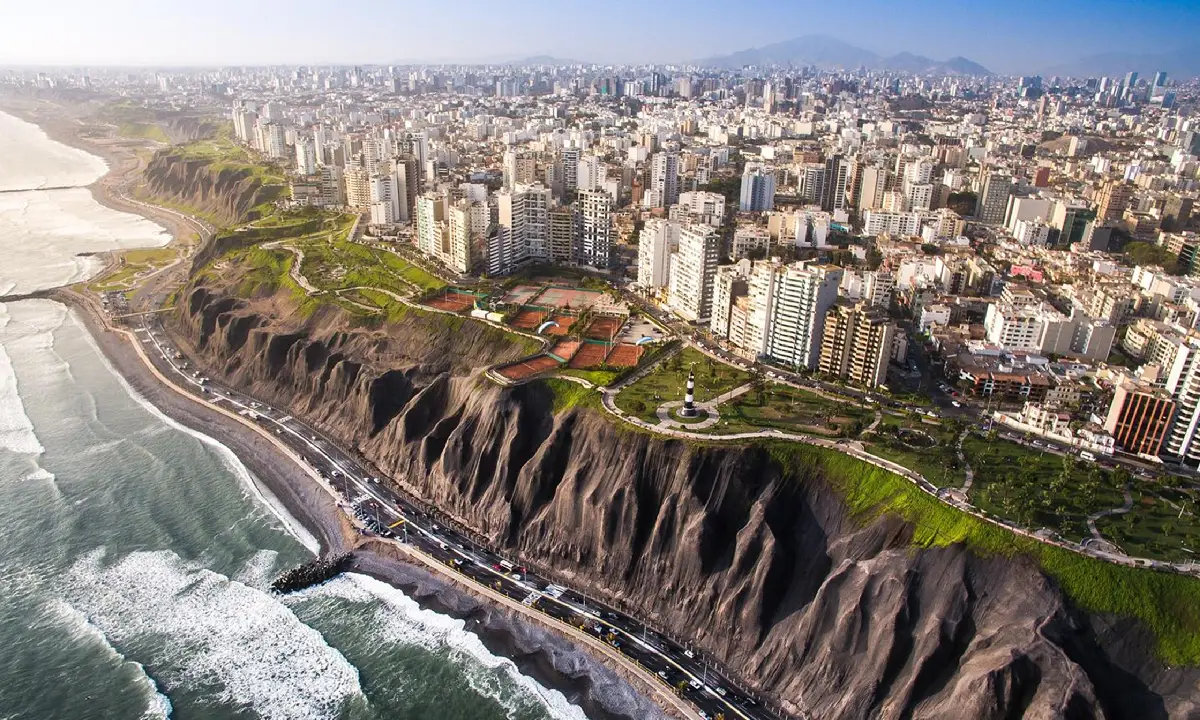
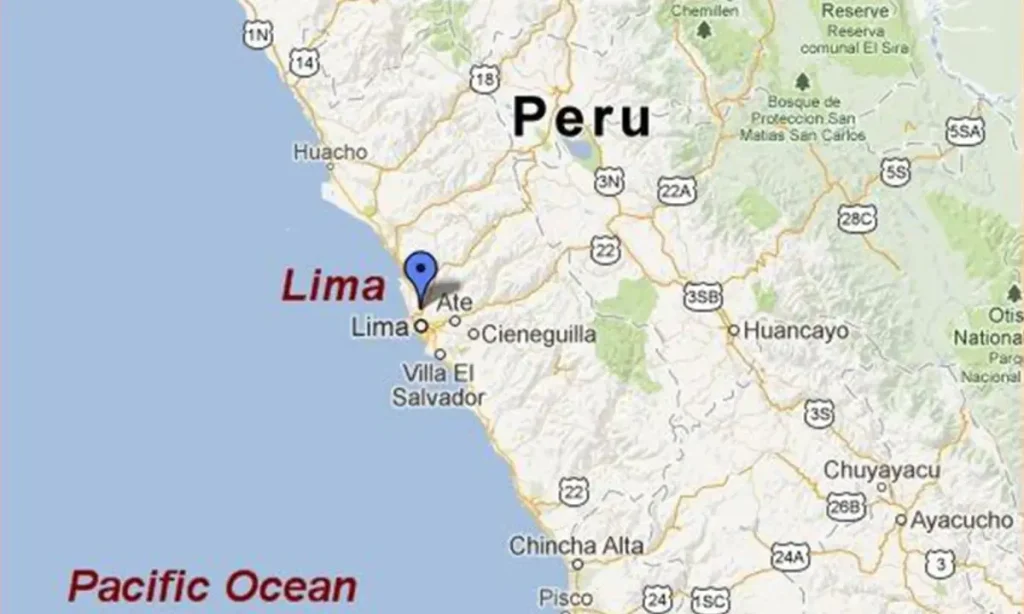
Lima and Callao are located on Peru’s central Pacific coast, in the western part of the country.
Together, they form Peru’s largest metropolitan area and the main international gateway to the country.
Located approximately 12° south of the Equator, Lima sits on a coastal plain crossed by valleys formed by rivers descending from the Andes toward the Pacific.
Callao lies immediately west of Lima, facing the ocean and surrounding Peru’s principal port.
Lima & Callao at a Glance
| 📍 Location | Central-western Peru, on the Pacific coast |
| 🌎 Latitude | Approximately 12° South |
| 📏 Altitude | Low elevation, varying across the metropolitan area |
| 🌊 Ocean | Pacific Ocean |
| 🏔️ East | The Andes rise east of Lima |
| 🏙️ Metropolitan Area | Lima and Callao form one interconnected urban region |
| ✈️ International Gateway | Jorge Chávez International Airport |
| ⚓ Historic Port | Callao |
| 🛏️ Recommended Stay | 2–3 nights, or longer for deeper cultural and culinary experiences |
Why Does Its Location Matter?
Lima’s geography is one of the reasons the city feels so different from many other capitals.
To the west is the Pacific Ocean.
To the east, the Andes begin to rise.
Between them lies one of the world’s most unusual urban environments: a major city built in the middle of a coastal desert.
This location also helps explain Peru’s extraordinary culinary and cultural diversity.
The Pacific provides an extraordinary variety of seafood. The valleys around Lima support agriculture despite the desert environment, while the Andes and Amazon are connected to the capital through centuries-old trade routes and modern transportation.
Lima is, in many ways, where the different worlds of Peru meet.
Where Peru Begins
The Pacific on one side.
The Andes rising beyond the horizon.
A desert transformed into a city.
And centuries of stories waiting to be discovered.
This is Lima.
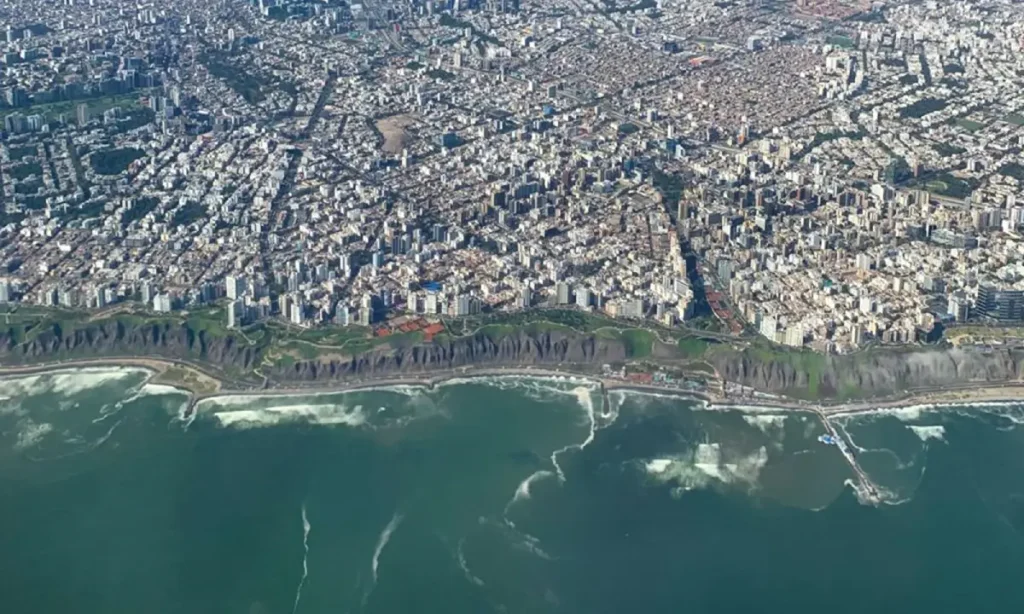
Located on Peru’s central Pacific coast, at approximately 12° south of the Equator, Lima is the country’s capital and its main gateway to the world.
Immediately to the west lies the Pacific Ocean; to the east, the Andes begin their ascent. Beyond Lima, the landscape changes dramatically, connecting the coast with the mountains and, farther east, the Amazon.
At low altitude, Lima feels very different from the high Andes. Its climate, shaped by the Pacific and its position in one of the world’s driest coastal deserts, gives the city its distinctive atmosphere: soft coastal light, dramatic cliffs, ocean horizons and long stretches of desert.
But geography is only the beginning.
Lima is a city that reveals Peru one layer at a time.
Walk through its historic center and you’ll encounter centuries-old churches, carved wooden balconies and courtyards where history still seems close enough to touch.
Look beneath the modern city and you’ll find ancient ceremonial centers built long before Lima existed as a Spanish capital.
Follow the coast and the city changes again.
In Miraflores, the Pacific stretches endlessly beyond the cliffs.
In Barranco, colorful streets, art, music and cafés create a slower, more creative rhythm.
And in Callao, Peru’s historic maritime gateway, the ocean becomes part of the city’s character.
Then there is the food.
Perhaps nowhere else can you taste so many different parts of Peru in a single city.
A City Shaped by Many Worlds
Lima’s story began long before the Spanish arrived.
Ancient civilizations flourished along this seemingly impossible landscape, learning to live with the desert and drawing life from rivers descending from the Andes.
At Huaca Pucllana, a monumental pre-Hispanic ceremonial center rises in the middle of the modern city.
At Pachacamac, the scale of the ancient sacred landscape reveals how deeply spirituality was woven into the lives of Peru’s early civilizations.
Then came the Spanish, followed by centuries of cultural encounters that transformed Lima into one of the most important cities in colonial South America.
But Peru’s story did not stop there.
Indigenous traditions, Spanish heritage, African culture, Chinese and Japanese migration, and influences from many other communities gradually became part of Lima’s identity.
You can taste that history, see it in the architecture, hear it in the music and feel it in traditions that continue today.
Faith Lives in the Streets
In Peru, faith is not something that belongs only inside a church.
It walks through the streets.
It appears in the purple robes and incense of the Señor de los Milagros processions, in the devotion to Santa Rosa de Lima, in the legacy of San Martín de Porres, and in traditions carried by Peruvian families from one generation to another.
Lima’s historic center is filled with remarkable churches, monasteries and convents.
The Cathedral of Lima, San Francisco, with its famous catacombs, and Santo Domingo offer encounters with religious art, architecture and history.
What makes Peru’s religious heritage particularly fascinating is that it remains alive.
Here, faith is history, art, music, tradition and community at the same time.
Following the Footsteps of Pope Leo XIV
Callao offers another, much more contemporary chapter in Peru’s religious story.
Before becoming Pope Leo XIV, Robert Francis Prevost spent many years serving Catholic communities in Peru. His work created deep connections with the people and places where he lived and served.
Today, Los Caminos del Papa León XIV allows visitors to discover places in Callao connected with his years of pastoral service and learn about the communities that became part of his life in Peru.
This is more than a religious visit.
It is a human story about service, community and a remarkable connection between a future pope and Peru.
Barranco
Lima’s Creative Soul
If historic Lima tells you about the city’s past, Barranco tells you something about its soul.
Colorful houses, old mansions, artists’ studios, galleries, murals, cafés and restaurants fill its streets.
The famous Puente de los Suspiros leads toward the ocean, while the Bajada de Baños descends gently toward the Pacific.
Barranco rewards curiosity.
You might discover a small gallery behind an unassuming doorway, stop for coffee beneath an old balcony, find a piece of contemporary Peruvian art or simply watch the light change over the Pacific.
As evening arrives, the neighborhood takes on another personality.
Restaurants fill with conversation.
Cocktail bars come alive.
Music drifts through the streets.
Barranco is not a place to rush through.
It is a place to wander.
Callao
Where Peru Meets the Pacific
Callao has always looked toward the sea.
As Peru’s historic port, it became a place where people, goods, cultures and ideas arrived from across the Pacific and beyond.
Today, Callao retains a personality distinctly its own.
The Real Felipe Fortress recalls the city’s strategic importance.
La Punta reaches into the Pacific, offering ocean views and a glimpse of Callao’s maritime character.
And Monumental Callao has become a vibrant cultural space where murals, art, architecture and local life meet.
Callao is not simply an extension of Lima.
It has its own stories to tell.
For travelers who want to see a side of Peru beyond the classic itinerary, those stories can be particularly rewarding.
The Pacific Is Part of the Experience
Lima is one of the world’s few capitals where the ocean is always close.
From the cliffs of Miraflores and Barranco, the Pacific stretches toward the horizon.
Surfers follow the waves below.
Paragliders drift above the coastline.
Cyclists trace the Malecón.
And locals gather to watch the sun disappear into the ocean.
The Pacific also gives Lima something even more important:
its extraordinary seafood.
And that brings us to one of the city’s greatest stories.
A Culinary Journey Through Peru
Come hungry. Lima has a country to show you.
Peruvian gastronomy did not become extraordinary by accident.
Its roots reach deep into ancient Peru and into the country’s remarkable biodiversity.
The Pacific provides an astonishing variety of fish and seafood.
The Andes contribute:
- Potatoes
- Corn
- Quinoa
- Ajíes
- Native tubers
- Herbs
The Amazon brings fruits, fish, spices and ingredients that continue to surprise even experienced chefs.
And Lima brings them all together.
Then add centuries of cultural exchange.
Indigenous traditions met Spanish cooking.
African heritage transformed Peruvian cuisine.
Chinese immigrants created Chifa.
Japanese immigrants developed Nikkei cuisine.
Italian and other European influences added yet more layers.
The result is not simply fusion.
It is Peruvian.
That is why a plate of food in Lima can tell the story of an entire country.
A ceviche can take you to the Pacific.
A potato can take you to the Andes.
An Amazonian fruit can transport you deep into the rainforest.
And a Nikkei dish can tell the story of generations who crossed an ocean and made Peru their home.
Lima’s World-Class Dining Scene
Today, this extraordinary culinary heritage has reached remarkable heights.
Lima is home to more than twenty restaurants that regularly appear in leading national, regional or international dining guides and rankings, giving travelers an extraordinary range of fine-dining experiences.
Restaurants such as:
- Maido
- Kjolle
- Mérito
- Mayta
- Central
- Astrid y Gastón
- Rafael
- La Mar
- Isolina
- Cosme
- Osaka
represent very different interpretations of Peruvian cuisine.
Some explore the country’s ecosystems and native ingredients.
Others celebrate ceviche and seafood.
Some focus on Nikkei or Chifa traditions.
Others reinterpret the dishes of everyday Peru with extraordinary precision.
And then there are neighborhood restaurants, markets, cevicherías and huariques, where you can experience something equally important:
the food Peruvians actually love to eat.
Because Peru’s culinary magic does not belong only to expensive restaurants.
Sometimes the most memorable meal is the simplest one.
Luxury, the Peruvian Way
Lima also offers a sophisticated introduction to luxury travel.
Exceptional hotels, private guides, exclusive cultural experiences, outstanding restaurants and personalized service can all become part of your journey.
But at PeruAgency, we believe true luxury is not measured simply by the number of stars on a hotel door.
Luxury is having the right experience, in the right place, at the right moment.
It is having a private guide who understands what fascinates you.
It is finding the perfect table at a restaurant you have dreamed of visiting.
It is entering a historic place with someone who can reveal the story behind it.
It is watching the sunset over the Pacific without looking at the clock.
Luxury is having your journey feel completely yours.
Lima Through Your Eyes
Lima can be a city of history.
A city of faith.
A city of food.
A city of art.
A city of the Pacific.
A city of luxury.
Or all of them at once.
A traveler fascinated by history may spend the morning discovering ancient Lima and its colonial heritage, followed by an extraordinary dinner.
A food lover may build an entire journey around markets, ceviche, Nikkei cuisine and some of Lima’s most celebrated restaurants.
A couple may combine Barranco, the Pacific, fine dining and a private cultural experience.
A traveler interested in faith may follow Lima’s religious heritage and continue into Callao to explore the footsteps of Pope Leo XIV.
There is no single way to experience Lima.
And that is precisely why it belongs in a tailor-made journey.
How Long Should You Stay?
For many travelers, 2–3 nights provide a wonderful introduction to Lima.
But if gastronomy, religious heritage, art, museums, Callao, luxury experiences or nearby archaeological sites are important to you, staying longer allows the city to unfold without rushing.
Lima can also be combined beautifully with Paracas, the Ballestas Islands and other coastal experiences.
It can also serve as the perfect beginning or ending to a longer journey through the Andes and Amazon.
Your Lima Begins Here
Perhaps your first memory of Peru will be the Pacific.
Perhaps it will be the aroma of ají in a market.
Perhaps the silence of an ancient temple.
The purple robes of a procession.
A sunset in Barranco.
A conversation with a local guide.
Or the first unforgettable dish of your journey.
Whatever brings you to Lima, let us make it personal.
At PeruAgency, we do not believe in sending travelers through Peru following someone else’s itinerary.
We listen, we understand what inspires you, and we bring together the places, people, flavors and experiences that will make the journey yours.
Because Lima is where Peru begins.
But your story is where the journey truly starts.
Tailor-Made Journeys with Purpose.